
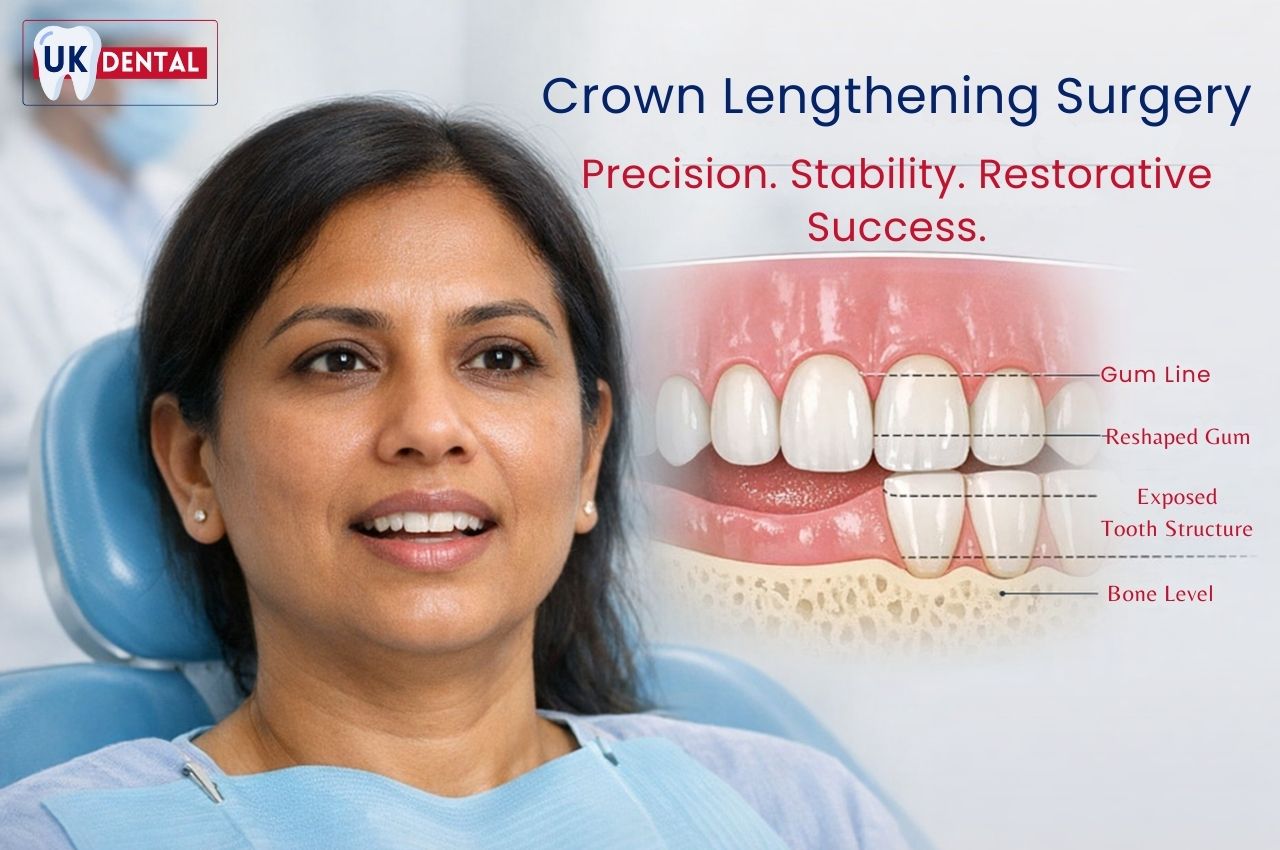

Let’s be honest—dentistry often sounds more intimidating than it really is. Crown lengthening surgery, though, is one of those procedures that looks complex on paper but feels surprisingly straightforward when planned and executed well. In this Crown Lengthening Surgery: A Complete Step-by-Step Clinical Guide 4, we unpack the science, the strategy, and the subtle artistry behind a precision-driven periodontal procedure designed to expose additional healthy tooth structure by reshaping gum tissue—and, when required, the supporting bone.
We don’t treat crown lengthening as a one-off fix. Instead, we approach it as both a restorative and aesthetic solution, engineered to deliver predictable outcomes that support long-term oral health, functional stability, and visual harmony. From indications and diagnostics to recovery and maintenance, this guide is built to meet the highest standards of clarity, depth, and clinical accuracy—without sounding robotic or repetitive. Ready? Let’s dive in.
Understanding Crown Lengthening in Modern Dentistry
At its core, crown lengthening increases the visible portion of a tooth above the gum line. Why does that matter? Because restorations—crowns, veneers, onlays—need a stable, healthy foundation to last. When tooth structure is hidden beneath the gums or bone, restorations risk failure, inflammation, or recurrent decay.
Beyond function, crown lengthening plays a starring role in aesthetic dentistry. By re-establishing proper tooth-to-gum proportions, it corrects excessive gingival display (that “gummy smile”) and restores balance to the smile. In short, it’s dentistry where biology meets beauty—and they actually get along.
Clinical Situations That Require Crown Lengthening
We recommend crown lengthening when specific clinical conditions compromise restoration success or aesthetic balance. Let’s break down the most common scenarios.
Deep Subgingival Tooth Decay
When decay extends below the gum margin, placing a restoration without violating biological width becomes tricky—sometimes impossible. Crown lengthening creates a clean, accessible margin, ensuring restorations can be sealed properly and maintained easily.
Fractured Teeth Below the Gum Line
A fracture at or beneath the gingival level often leaves insufficient tooth structure for crown retention. By surgically exposing sound tooth structure, crown lengthening allows predictable reconstruction instead of extraction. And yes—that’s a win.
Insufficient Clinical Crown Height
Short teeth don’t always play nice with crowns or bridges. Without adequate height, restorations lack mechanical retention. Crown lengthening improves stability, longevity, and peace of mind.
Gummy Smile Correction
Excess gum tissue can mask natural tooth length, throwing off smile proportions. Aesthetic crown lengthening recontours gingiva for a balanced, natural look—subtle, refined, and confidence-boosting.
Comprehensive Pre-Surgical Assessment and Planning
Here’s where the magic actually begins. Successful outcomes don’t start in the operatory; they start with meticulous planning.
We conduct a detailed evaluation that includes:
- Comprehensive periodontal examination
- Digital radiographic analysis to assess bone levels
- Measurement of biological width
- Smile design analysis for anterior aesthetic cases
This diagnostic phase determines whether soft-tissue reshaping alone will do the job—or if osseous recontouring is required. Rushing this step? Not an option. Precision now prevents complications later.
Step-by-Step Crown Lengthening Surgical Protocol
Below is a clinically grounded walkthrough from incision to suturing—clear, systematic, and predictable.
1. Local Anesthesia and Surgical Preparation
We administer targeted local anesthesia to ensure complete comfort. The surgical field is isolated and prepared under sterile conditions. Patient comfort? Checked. Surgical clarity? Checked.
2. Precision Gingival Incisions
Controlled incisions are placed to reflect the gum tissue while preserving healthy architecture. This allows unobstructed visualization of the underlying tooth and bone—no guesswork involved.
3. Soft Tissue Reflection
The gingival flap is gently repositioned to expose tooth structure and alveolar bone. Careful handling here is key; healthy tissue responds better and heals faster.
4. Osseous Recontouring (When Indicated)
If bone levels encroach on the required restorative margin, selective bone reshaping is performed to re-establish proper biological width. This step ensures long-term periodontal stability—non-negotiable.
5. Gingival Repositioning and Suturing
The gum tissue is repositioned apically and secured using fine sutures designed to promote optimal healing and contour stability. The goal? Natural contours that stay put.
Crown Lengthening Procedure Flow (Visual Overview)
Clinical Flow Summary:
Clinical Assessment → Local Anesthesia → Gingival Incisions → Tissue Reflection → Bone Adjustment (if needed) → Gingival Repositioning → Suturing & Healing Phase
Simple on paper. Surgical poetry in practice.
Therapeutic and Functional Advantages
Crown lengthening delivers benefits that extend well beyond immediate restoration needs:
- Improved crown retention and marginal integrity
- Reduced risk of recurrent decay
- Enhanced access for daily oral hygiene
- Stable periodontal architecture
- Harmonized gum-to-tooth proportions in aesthetic zones
Together, these outcomes support long-term restorative success and periodontal health. That’s value you can actually measure.
Recovery Timeline and Healing Expectations
Healing follows a structured progression that we monitor closely through scheduled follow-ups. Here’s what patients can realistically expect.
Immediate Post-Surgical Phase (Days 1–3)
- Mild discomfort managed with prescribed medication
- Localized swelling controlled using cold compresses
- Temporary dietary and oral hygiene modifications
Nothing dramatic—just sensible care.
Intermediate Healing Phase (Weeks 2–4)
- Gradual reduction in tenderness
- Soft tissue maturation
- Suture removal if required
Progress is steady, not rushed.
Final Healing Phase (8–12 Weeks)
- Complete gingival stabilization
- Readiness for final crown placement
- Long-term tissue contour refinement
Patience here pays off—big time.
Post-Operative Care and Long-Term Maintenance
Surgical success doesn’t end with the last suture. It’s reinforced through disciplined aftercare.
We advise:
- Gentle but thorough oral hygiene practices
- Avoidance of smoking and traumatic chewing habits
- Compliance with prescribed medications
- Regular periodontal evaluations
Consistency preserves surgical results and protects the longevity of subsequent restorations. Skip maintenance? Results fade. Stick with it? Smiles last.
Cost Considerations and Treatment Value
The investment in crown lengthening varies depending on:
- Number of teeth involved
- Soft tissue versus combined bone modification
- Complexity of the surgical site
From a clinical perspective, crown lengthening prevents premature restoration failure, recurrent decay, and periodontal complications—delivering substantial long-term value. In other words, it’s not an expense; it’s a safeguard.
Clinical Takeaways
- Crown lengthening is foundational in advanced restorative dentistry
- It enables durable crown placement while preserving periodontal health
- The procedure enhances both function and aesthetics
- Long-term success depends on precise execution and patient compliance
When performed with meticulous planning and surgical accuracy, outcomes are predictable, stable, and genuinely satisfying.
FAQs About Crown Lengthening Surgery
Is crown lengthening painful?
Not really. With modern anesthesia and post-op care, discomfort is typically mild and short-lived.
How long before I can get my final crown?
Usually 8–12 weeks, allowing complete tissue stabilization.
Will my smile look different?
Yes—in a good way! Tooth proportions often look more balanced and natural.
Is crown lengthening permanent?
When properly maintained, results are long-lasting and stable.
Can crown lengthening fail?
Rarely, but inadequate planning or poor aftercare can compromise outcomes. Precision matters.
Conclusion
In this Crown Lengthening Surgery: A Complete Step-by-Step Clinical Guide 4, we’ve shown that crown lengthening isn’t just a surgical technique—it’s a strategic investment in oral health, restorative longevity, and confident smiles. By exposing healthy tooth structure, respecting biological principles, and embracing thoughtful planning, clinicians can deliver outcomes that stand the test of time.
We don’t view crown lengthening as a standalone surgery. We see it as part of a bigger picture—where function, aesthetics, and biology align beautifully. Executed with precision and supported by comprehensive aftercare, crown lengthening truly earns its place as one of modern dentistry’s most valuable procedures. And honestly? When done right, it’s dentistry at its finest.