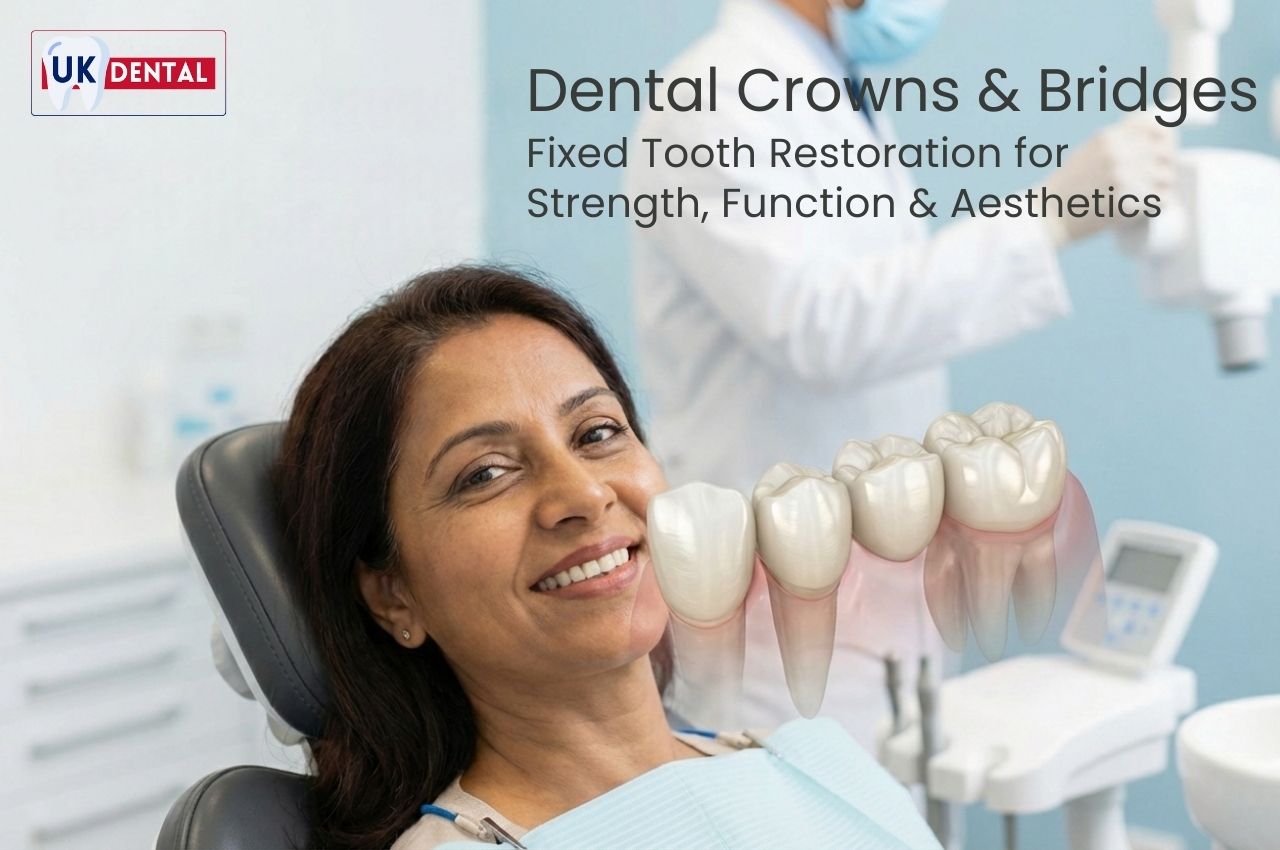

Let’s be honest—when a tooth breaks, weakens, or goes missing, it doesn’t just mess with your smile. It throws off chewing, speech, confidence, and sometimes even your mood. That’s where Dental Crowns and Bridges: A Complete, Clinical, and Practical Guide to Fixed Tooth Restoration comes into play.
We consider dental crowns and bridges to be foundational elements of modern restorative dentistry. These fixed prosthetic solutions restore strength, function, alignment, and aesthetics to compromised or missing teeth while preserving long-term oral harmony. When planned precisely and executed expertly, crowns and bridges blend so seamlessly into your natural dentition that you forget they’re even there—until you realize you’re chewing comfortably, speaking clearly, and smiling without hesitation.
This comprehensive, clinically grounded guide breaks down everything you need to know—without the stiff textbook vibe. We’ll walk through the science, the artistry, the practical steps, and the long-term outcomes, all in a friendly, human tone. So, grab a coffee and let’s dive in.
Understanding Fixed Dental Prosthesis in Contemporary Dentistry
Dental crowns and bridges belong to a category known as fixed dental prosthesis. In plain English? These restorations are permanently cemented in place. You don’t remove them at night, you don’t soak them in a cup, and you don’t worry about them shifting when you talk or eat.
Unlike removable appliances, fixed prosthetics function like natural teeth under everyday forces. Bite into an apple? No problem. Laugh mid-conversation? Still solid.
Fixed prosthetic restorations are designed to:
- Reinforce weakened tooth structure
- Replace missing teeth without mobility
- Maintain occlusal balance and arch integrity
- Preserve facial structure and jaw alignment
That stability is the secret sauce—it’s what makes crowns and bridges such dependable long-term solutions.
Dental Crowns: Full-Coverage Protection for Compromised Teeth
What Is a Dental Crown?
A dental crown is a custom-fabricated restoration that completely encases the visible portion of a tooth, providing structural reinforcement and surface protection. Often called a “cap,” it restores the tooth’s ideal shape, size, strength, and appearance.
Crafted with precision and bonded permanently, a crown doesn’t just sit on the tooth—it becomes part of it. Designed to mimic natural enamel contours, it feels natural, looks natural, and functions naturally. Once placed, most patients forget which tooth even has the crown. That’s a win.
Clinical Indications for Dental Crowns
We recommend crowns in a wide range of situations, including:
- Teeth weakened after root canal therapy
- Extensive decay that fillings simply can’t support
- Fractured, cracked, or severely worn teeth
- Cosmetic enhancement for discolored or misshapen teeth
- Structural coverage for dental implants
- Support for abutment teeth in dental bridges
If a tooth is hanging on by a thread, a crown often steps in as the hero.
Functional and Aesthetic Benefits of Dental Crowns
Dental crowns do more than “fix” a tooth—they future-proof it.
Key advantages include:
- Structural reinforcement against fracture
- Restoration of full chewing efficiency
- Natural color matching for seamless aesthetics
- Long-term durability under occlusal stress
- Protection of remaining healthy tooth structure
In short, crowns don’t just repair—they restore confidence.
Types of Dental Crowns and Material Selection
Choosing the right crown material is all about balance—strength, beauty, and longevity.
Common dental crown materials include:
- Porcelain-Fused-to-Metal (PFM): Strength plus cosmetic appeal
- All-Ceramic / All-Porcelain: Exceptional aesthetics, ideal for front teeth
- Zirconia Crowns: Outstanding strength with modern translucency
- Metal Crowns (Gold or Alloys): Maximum durability for back teeth
- E-Max Crowns: Lithium disilicate offering strength and lifelike translucency
Each material is selected based on bite force, tooth location, functional demands, and—yes—how good you want it to look.
Dental Bridges: Restoring Missing Teeth with Precision
What Is a Dental Bridge?
A dental bridge is a fixed prosthetic appliance used to replace one or more missing teeth. It anchors artificial teeth—called pontics—to adjacent natural teeth or dental implants, restoring continuity in the dental arch.
Think of it like reconnecting a broken link in a chain. Once placed, the bridge restores balance, stability, and confidence in everyday function.
Consequences of Untreated Missing Teeth
Ignoring missing teeth isn’t harmless—it sets off a domino effect.
Without restoration, patients may experience:
- Adjacent teeth drifting into the empty space
- Bite imbalance and altered occlusion
- Excessive wear on remaining teeth
- Gum recession and periodontal complications
- Increased risk of temporomandibular joint strain
Dental bridges stop that cascade in its tracks, preserving spacing and alignment.
Types of Dental Bridges
Bridge design isn’t one-size-fits-all. We tailor it to anatomy, support, and long-term prognosis.
Common bridge designs include:
- Traditional Fixed Bridge: Crowns on adjacent teeth support the pontic
- Cantilever Bridge: Anchored on one side only
- Maryland Bridge: Resin-bonded with minimal tooth preparation
- Implant-Supported Bridge: Anchored directly into jawbone implants
Each option has its place, and choosing the right one makes all the difference.
Step-by-Step Clinical Procedure for Crowns and Bridges
Restorative dentistry may look effortless when done well, but behind the scenes, it’s a carefully choreographed process.
Treatment Workflow Overview
- Comprehensive examination with radiographs and occlusal analysis
- Tooth preparation to accommodate the restoration
- Digital or physical impressions for laboratory fabrication
- Temporary crowns or bridges to protect prepared teeth
- Final fitting, bite adjustment, and permanent cementation
Every step matters—skip one, and the whole system feels off.
Longevity and Maintenance of Crowns and Bridges
With proper care, dental crowns and bridges routinely last 10–15 years, and often much longer. Some even keep going strong for decades.
Best Practices for Long-Term Success
- Brush daily with non-abrasive toothpaste
- Floss carefully around margins and under pontics
- Schedule regular professional checkups
- Avoid excessive biting forces (ice, pens, popcorn kernels—yeah, those)
- Address grinding or clenching early
Consistency, not perfection, keeps restorations thriving.
Crowns vs. Bridges: Functional Comparison
| Feature | Dental Crown | Dental Bridge |
| Purpose | Protects a damaged tooth | Replaces missing teeth |
| Tooth Coverage | Single tooth | One or more missing teeth |
| Support | Natural tooth or implant | Adjacent teeth or implants |
| Permanence | Fixed | Fixed |
| Functional Role | Strengthens tooth | Maintains arch integrity |
Different tools, different jobs—both essential.
Precision, Aesthetics, and Oral Harmony
Modern restorative dentistry isn’t just science—it’s craftsmanship. Advanced materials, digital scanning, and precision fabrication ensure crowns and bridges look and feel indistinguishable from natural teeth.
We approach every case as a balance of biology, engineering, and aesthetics. When those elements align, comfort follows—and so does confidence.
This is why Dental Crowns and Bridges: A Complete, Clinical, and Practical Guide to Fixed Tooth Restoration continues to define best practices in restorative care.
Frequently Asked Questions (FAQs)
Do dental crowns hurt to get?
Not usually. Local anesthesia keeps the procedure comfortable, and mild soreness afterward fades quickly.
How long do crowns and bridges really last?
With good care, 10–15 years is common—and longer isn’t rare.
Can crowns and bridges look natural?
Absolutely. Modern materials are designed to mimic natural enamel beautifully.
Are bridges better than implants?
It depends. Bridges are excellent solutions, but implants may be preferable in certain cases.
Can I eat normally with crowns and bridges?
Yes—once adjusted, they function just like natural teeth.
Conclusion
Dental crowns and bridges remain among the most reliable, sophisticated solutions in modern restorative dentistry. Their ability to protect compromised teeth, replace missing structures, and preserve long-term oral stability makes them indispensable in comprehensive care.
When thoughtfully planned and professionally maintained, these restorations deliver predictable, lasting results that support both function and appearance. By understanding their role, materials, procedures, and maintenance needs, patients can make confident, informed decisions—and enjoy the full benefits of fixed dental prosthetic solutions for years to come.
And honestly? That peace of mind is priceless.