
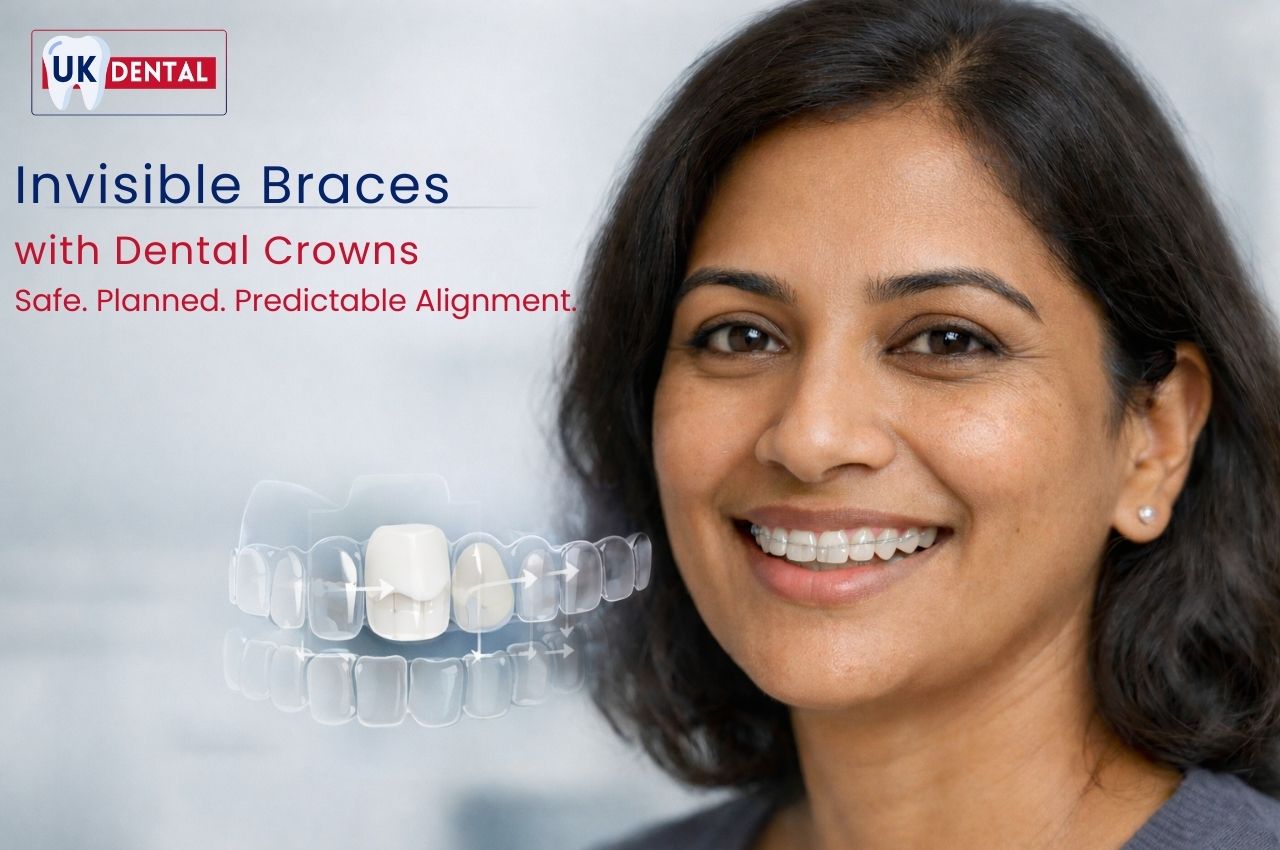

Achieving a straight, confident smile isn’t boxed in by age, lifestyle, or—surprise—prior dental restorations. These days, invisible braces have flipped the orthodontic script, offering discreet, comfortable, and impressively precise tooth movement without the metal-mouth vibes.
But let’s be real—if you’ve already got one or more dental crowns, a very fair question pops up: Can invisible braces work with crowned teeth?
Short answer? Yes.
Long answer? That “yes” comes with smart planning, advanced diagnostics, and expert supervision. Invisible braces and dental crowns are not mutually exclusive. When approached thoughtfully, aligner therapy can be safe, predictable, and beautifully effective—even with crowns in the mix.
This guide—Invisible Braces with Dental Crowns: A Complete, Practical Guide to Safe & Predictable Teeth Alignment—dives deep into how the two coexist, what factors influence success, and how clinicians fine-tune treatment for long-term stability. No fluff. No guesswork. Just clear, clinic-grade insight delivered in plain English.
Understanding Invisible Braces (Clear Aligners)
Invisible braces—often called clear aligners—are custom-fabricated orthodontic trays that gently guide teeth into alignment over time. Instead of wires and brackets doing the heavy lifting, aligners rely on precision biomechanics and digital planning.
Core Characteristics of Invisible Braces
- Transparent, medical-grade thermoplastic
- Removable for eating, brushing, and flossing
- Digitally planned tooth movements
- Typically worn 20–22 hours a day
- Replaced every 7–14 days, depending on protocol
Each aligner applies a calculated amount of force. Not brute strength—more like a chess game than a wrestling match. Rotations, intrusions, extrusions, and translations are all pre-mapped using digital simulations, making outcomes remarkably predictable—even in complex cases.
And yes, this same precision is what makes Invisible Braces with Dental Crowns: A Complete, Practical Guide to Safe & Predictable Teeth Alignment possible in the first place.
What Is a Dental Crown?
A dental crown is a full-coverage restoration placed over a tooth that’s been compromised—by decay, fracture, root canal treatment, or structural weakness. Its job is simple yet critical: restore strength, function, and aesthetics.
Common Crown Materials Include
- Porcelain-fused-to-metal (PFM)
- Full ceramic or porcelain
- Zirconia
- Metal alloys
Crowns are permanently cemented and built to withstand normal biting forces. However—and this matters—their surface chemistry is very different from natural enamel. That difference plays a key role in orthodontic attachment bonding.
Compatibility of Invisible Braces with Dental Crowns
Here’s where myths start to crumble.
Invisible braces are broadly compatible with crowned teeth. The real distinction isn’t whether alignment is possible—it’s how treatment is engineered.
The Attachment Factor
Aligners often rely on tiny, tooth-colored attachments (also called engagers). These help the aligner grip the tooth and control movement. Attachments bond easily to enamel—but crowns? They require a different approach.
Key Clinical Adaptations
- Specialized surface conditioning of the crown
- Alternative attachment shapes or placement strategies
- Selective omission of attachments on crowned teeth
- Redistribution of force through adjacent natural teeth
Modern aligner systems factor all this in during digital planning. The result? Efficient biomechanics without compromising the crown’s integrity. That’s the science behind Invisible Braces with Dental Crowns: A Complete, Practical Guide to Safe & Predictable Teeth Alignment.
Clinical Factors That Influence Treatment Success
Not all crowns—or mouths—are created equal. Success depends on a few critical variables.
Favorable Indicators
- Well-fitted, stable crown margins
- Healthy underlying tooth structure
- Good periodontal (gum) health
- Crowns made from modern ceramic or zirconia
- Adequate number of natural teeth supporting movement
Conditions Requiring Advanced Evaluation
- Crowns older than 10–15 years
- History of decay under the crown
- Marginal leakage or looseness
- Advanced gum disease
- Uncertainty about crown material
Here’s the silver lining: a crown that needs replacement isn’t a setback. It’s often a golden opportunity to optimize both orthodontic and restorative outcomes at the same time.
Why a Comprehensive Dental Examination Is Essential
Aligner therapy should never kick off without a full diagnostic workup—especially when crowns are involved. No shortcuts here.
A Complete Evaluation Includes
- Digital intraoral scans
- Radiographic analysis (X-rays or CBCT, if needed)
- Crown integrity and margin assessment
- Occlusal (bite) analysis
- Periodontal health evaluation
- Functional jaw alignment review
This diagnostic phase ensures aligner forces are applied to a stable, disease-free foundation. When needed, crown replacement or modification happens before aligners start—preventing mid-treatment headaches.
How Aligner Mechanics Are Adapted for Crowns
Biologically speaking, a tooth with a crown responds to orthodontic forces just like any other tooth. The bone doesn’t care what’s on top. What does change is how force gets delivered.
Common Mechanical Adjustments
- Crowned teeth moved indirectly using neighboring teeth as anchors
- Attachments avoided on crown surfaces
- Reduced-force protocols applied
- Movement sequencing adjusted digitally
Thanks to sophisticated planning software, these tweaks rarely lengthen treatment time or compromise results. Precision wins the day.
Monitoring, Care, and Maintenance During Treatment
Patients with crowns don’t need extra drama—just smart monitoring.
Recommended Care Protocols
- Scheduled orthodontic check-ins
- Routine crown stability checks
- Strict adherence to aligner wear time
- Excellent oral hygiene habits
- Gentle insertion and removal of aligners
When protocols are followed, crowns rarely loosen during aligner therapy. Simple as that.
Cost Considerations and Financial Transparency
Good news first: having a crown doesn’t automatically jack up the cost of invisible braces.
Pricing Is Influenced By
- Complexity of tooth movement
- Number of aligners required
- Overall treatment duration
- Any necessary pre-aligner dental work
If restorative work is recommended, it’s discussed upfront—no financial curveballs, no awkward surprises.
Aesthetic Precision for Front-Tooth Crowns
Crowns in the smile zone? That’s where planning gets extra meticulous.
Digital simulations help clinicians:
- Preserve smile harmony throughout treatment
- Keep attachments discreet
- Preview post-treatment aesthetics before aligners are made
The result? Orthodontic progress that looks good every step of the way.
FAQs: Invisible Braces with Dental Crowns
Can invisible braces damage my crown?
Not when planned correctly. Forces are controlled and adapted to protect restorations.
Will attachments stick to crowns?
Sometimes. If not, alternative strategies are used—no problem.
Do crowned teeth move slower?
No. The underlying tooth and bone respond normally.
Should I replace an old crown before aligners?
Often, yes. It can improve both orthodontic and long-term restorative results.
Is treatment time longer with crowns?
Usually not, provided planning is done properly.
Final Perspective: Precision Over Assumptions
Invisible braces with dental crowns aren’t a compromise—they’re a calculated, evidence-based solution when managed correctly. Success hinges on:
- Thorough diagnostics
- Individualized biomechanics
- Expert-led digital planning
- Continuous monitoring
When these pieces click, aligner therapy delivers stable, predictable, and aesthetically superior results—crowns or not.
Conclusion: Ready to Move Forward?
A professionally guided orthodontic assessment is the first step toward a confident, well-aligned smile. With modern aligner technology and restoration-aware planning, crowns aren’t obstacles—they’re just another variable mastered through precision.
Invisible Braces with Dental Crowns: A Complete, Practical Guide to Safe & Predictable Teeth Alignment proves one thing loud and clear: straight teeth and crowns can absolutely coexist—beautifully.
Disclaimer: Treatment outcomes, duration, and costs may vary based on individual dental conditions, material considerations, and clinical findings at the time of evaluation.